ULEP Ultra Lightweight Embedded Protocol
Ultra Lightweight Embedded Protocol is a TCP/IP application protocol designed to provide connection for a large number of similar devices. Similarly like in subscribe/publish model data is associated with topics, however it doesn’t require client devices to subscribe to it. Topics are described by numbers in range 1-63 and can be mapped to every client on the server side.
Protocol was created to provide a transport layer for applications running over limited bandwidth or data transfer cost expensive link, e.g. satellite connection.
System basis on large, but limited number of active clients, which connect to the base server using TCP/IP protocol. System allows to change the format of some communications between users and server. Because of that it is required to have consistent configuration of all devices.
System can work in 2 modes:
Protocol provides distinction of messages sent by different clients. Every client has its own ID in range (by default) 0x01-0xFFFFFFFF. Every incoming connection is assigned to a particular device, what can be stored in an external database. Authorization and authentication can also be based on an external database.
Client connects to a known server application using CONNECT message:
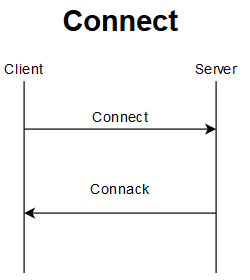
Chart 3.1 Connect workflow
For connect message server will answer with a connack. If connection is successful, data transmission can begin in both directions:
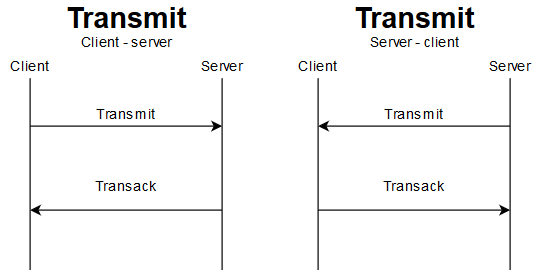
Chart 3.2 Data transmission workflow
When a client decides to close the connection, it has to send a disconnect message. After receiving this message, there should be no further data flow:

Chart 3.3 Disconnect workflow
All messages starts with header byte which has format shown in table 4.1.1:
|
Bit number |
7 |
6 |
5 |
4 |
3 |
2 |
1 |
0 |
|
Description |
Type |
Type specific usage |
||||||
Table 4.1.1bHeader byte format
All messages have type value present in bits 7 and 6 in byte 1. These types are described in Table 4.1.2.
|
Type |
Value |
Description |
|
CONNECT/CONNACK |
0x00 |
Message sent while connecting and acknowledging connection |
|
TRANSMIT |
0x40 |
Message sent from client to server and from server to client |
|
TRANSACK |
0x80 |
Acknowledge message just after receiving message |
|
DISCONNECT |
0xC0 |
Message sent while client disconnects |
Table 4.1.2 Message types
Client is the side, which initializes connection. Client sends a fixed length message of connect type and waits for a response from the server with a connack message. Connack has a fixed length of 1 byte. Connect and connack messages are the same type.
Connect message is 22 byte long message, which should be sent by client during first communication. It contains 4 information in proper bit configuration described in table 4.2.1.1. Those values are:
|
Byte 1 |
||||||||
|
Bit number |
7 |
6 |
5 |
4 |
3 |
2 |
1 |
0 |
|
Description |
Type (0x40) |
Dup |
Keep alive |
|||||
|
Values |
0 |
0 |
X |
X |
X |
X |
X |
X |
|
Byte 2-6 (default) |
||||||||
|
Bit number |
7 |
6 |
5 |
4 |
3 |
2 |
1 |
0 |
|
Description |
Client ID |
|||||||
|
Values |
X |
X |
X |
X |
X |
X |
X |
X |
|
Byte 7-22 (default) |
||||||||
|
Bit number |
7 |
6 |
5 |
4 |
3 |
2 |
1 |
0 |
|
Description |
API Key |
|||||||
|
Values |
X |
X |
X |
X |
X |
X |
X |
X |
Table 4.2.1.1
Connack message is 1 byte long and contains 2 fields:
Format of connack message is described in table 4.2.2.1
|
Byte 1 |
||||||||
|
Bit number |
7 |
6 |
5 |
4 |
3 |
2 |
1 |
0 |
|
Description |
Type (0x00) |
Return code |
||||||
|
Values |
0 |
0 |
X |
X |
X |
X |
X |
X |
Table 4.2.2.1
Return codes are described in table 4.2.1.2
|
Value |
Name |
Description |
|
0x00 |
CONN_OK |
Connection successful |
|
0x01 |
AUTH_FAIL |
Authorization failed - wrong API key |
|
0x02 |
ID_PROHIBITED |
Wrong client ID value - server doesn’t allow it to authenticate |
|
0x03 |
CONN_NOK |
Unknown (other) issue |
Table 4.2.1.2
Transmit message contains 3 bytes header followed by defined data bytes containing message.
|
Byte 1 |
||||||||
|
Bit number |
7 |
6 |
5 |
4 |
3 |
2 |
1 |
0 |
|
Description |
Type (0x40) |
Topic identifier |
||||||
|
Values |
0 |
1 |
X |
X |
X |
X |
X |
X |
|
Byte 2 |
||||||||
|
Bit number |
7 |
6 |
5 |
4 |
3 |
2 |
1 |
0 |
|
Description |
Message ID |
|||||||
|
Values |
X |
X |
X |
X |
X |
X |
X |
X |
|
Byte 3 |
||||||||
|
Bit number |
7 |
6 |
5 |
4 |
3 |
2 |
1 |
0 |
|
Description |
Message length |
|||||||
|
Values |
X |
X |
X |
X |
X |
X |
X |
X |
|
Byte 4+ (optional) |
||||||||
|
Bit number |
7 |
6 |
5 |
4 |
3 |
2 |
1 |
0 |
|
Description |
User data |
|||||||
|
Values |
X |
X |
X |
X |
X |
X |
X |
X |
Table 4.3.1
Transack message has a fixed length of 2 bytes and its content should be equal to the first 2 bytes of the transmit message which it is acknowledging except of the message type. Message should point to the received message by its topic identifier and message ID. Description of message is presented in table 4.4.1.
|
Byte 1 |
||||||||
|
Bit number |
7 |
6 |
5 |
4 |
3 |
2 |
1 |
0 |
|
Description |
Type (0x80) |
Topic identifier |
||||||
|
Values |
1 |
0 |
X |
X |
X |
X |
X |
X |
|
Byte 2 |
||||||||
|
Bit number |
7 |
6 |
5 |
4 |
3 |
2 |
1 |
0 |
|
Description |
Message ID |
|||||||
|
Values |
X |
X |
X |
X |
X |
X |
X |
X |
Table 4.4.1
Ping and pong messages are introduced to provide control of keeping a connection alive. Those messages derive from Transmit and Transack messages. Topic identifier 0x00 is reserved for ping messages. Ping message is sent from client device to server, Pong is response from server to client on Ping message.
Every message received by the server is resetting the keep alive timer. Ping messages are simply null transmissions to reset this timer.
|
Byte 1 |
||||||||
|
Bit number |
7 |
6 |
5 |
4 |
3 |
2 |
1 |
0 |
|
Description |
Type (0x40) |
Topic identifier |
||||||
|
Values |
0 |
1 |
0 |
0 |
0 |
0 |
0 |
0 |
Table 4.5.1 Ping message
|
Byte 1 |
||||||||
|
Bit number |
7 |
6 |
5 |
4 |
3 |
2 |
1 |
0 |
|
Description |
Type (0x80) |
Topic identifier |
||||||
|
Values |
1 |
0 |
0 |
0 |
0 |
0 |
0 |
0 |
Table 4.5.2 Ping message
Disconnect message is fixed length of 1 byte and can be sent from client and server side. It contains only type value, presented in table 4.5.1. When this message is transmitted or received, both sides should close the connection.
|
Byte 1 |
||||||||
|
Bit number |
7 |
6 |
5 |
4 |
3 |
2 |
1 |
0 |
|
Description |
Type (0xC0) |
Reserved |
||||||
|
Values |
1 |
1 |
0 |
0 |
0 |
0 |
0 |
0 |
Table 4.6.1
Server settings:
Api key: 0123456789abcdef
Connect packet:
0x3C 0x00 0x00 0x00 0x01 0x30 0x31 0x32 0x33 0x34 0x35 0x36 0x37 0x38 0x39 0x61 0x62 0x63 0x64 0x65 0x66
Header - 0x00 type combined with 0x3C (60) of keep alive
Cliend ID - 0x00000001 - 1
Api key - 0123456789abcdef utf-8 encoded*
Connack packet:
0x00
Header - 0x00 type combined with 0x00 return code (OK)
Transmit packet (client -> server):
0x41 0x00 0x04 0x74 0x65 0x73 0x74
Header - 0x40 type combined with 0x01 (1) topic ID
Message ID - 0x00 (0) as counter starts from 0
Message length - 0x04 (4) bytes long
Message data - test utf-8 encoded
Transack packet (server -> client)
0x81 0x00
Header - 0x80 combined with 0x01 (1) topic ID
Message ID - 0x00 (0) as message ID of received message
Transmit packet (server -> client):
0x41 0x00 0x04 0x74 0x65 0x73 0x74
Header - 0x40 type combined with 0x01 (1) topic ID
Message ID - 0x00 (0) as counter starts from 0
Message length - 0x04 (4) bytes long
Message data - test utf-8 encoded
Transack packet (client -> server)
0x81 0x00
Header - 0x80 combined with 0x01 (1) topic ID
Message ID - 0x00 (0) as message ID of received message
Disconnect packet (client -> server)
0xC0
Header - 0xC0 as it is fixed message for disconnect